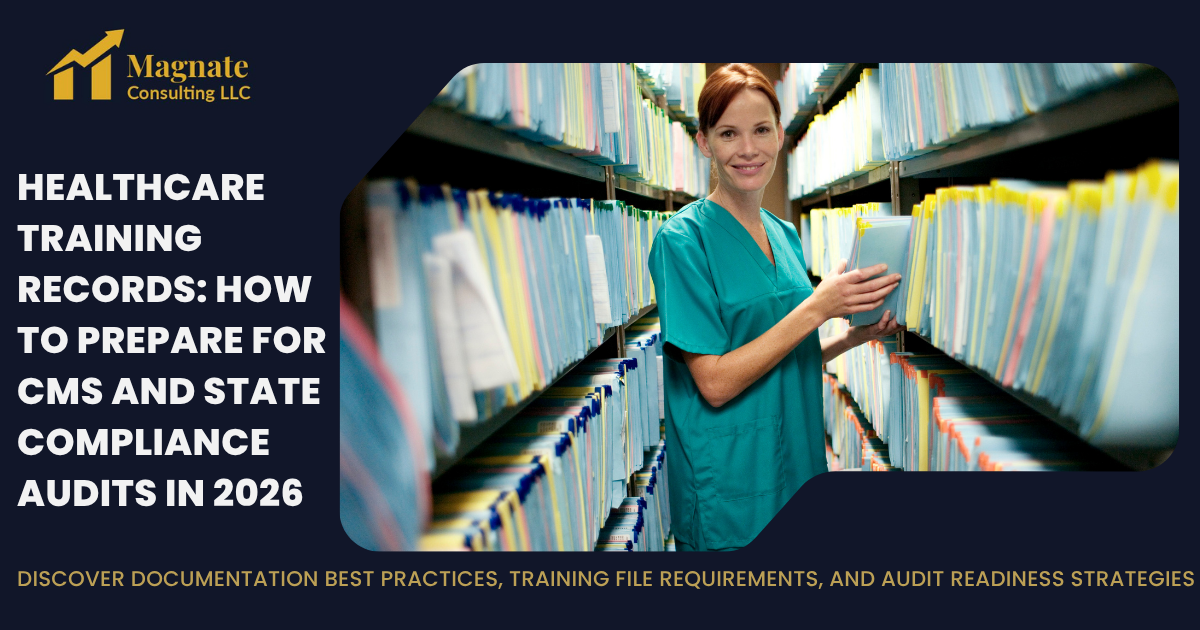
Healthcare organizations invest significant time and resources in staff training, but without accurate documentation, those efforts may not count during a compliance audit. Whether you operate a Home and Community-Based Services (HCBS) program, group home, home care agency, or other healthcare organization, maintaining complete healthcare training records is essential for demonstrating regulatory compliance and operational excellence.
In 2026, federal and state surveyors continue to examine training documentation to verify that employees have received required education, demonstrated competency, and remain qualified to perform their responsibilities safely. Missing records, outdated certifications, or incomplete competency assessments can lead to citations, corrective action plans, and increased regulatory scrutiny.
This guide explains what healthcare providers should document, common compliance mistakes to avoid, and how to build a training record system that supports successful audits.
Why Healthcare Training Records Matter
Training documentation provides objective evidence that employees possess the knowledge and skills required to deliver safe, person-centered care.
During inspections, surveyors don’t simply ask whether training occurred they expect providers to prove it.
Complete training records help organizations:
• Demonstrate compliance with CMS and state licensing requirements.
• Verify employee competency.
• Support quality assurance activities.
• Reduce regulatory risk.
• Improve workforce accountability.
• Strengthen organizational credibility during audits.
Without proper documentation, providers may struggle to show that staff received required education, even if the training actually occurred.
Regulatory Expectations in 2026
Healthcare providers participating in Medicare and Medicaid programs must ensure staff are trained, competent, and appropriately supervised according to applicable federal and state regulations.
For HCBS providers, the CMS HCBS Final Rule (42 CFR §441.301) continues to require qualified staff who support person-centered services and individual rights. Likewise, 42 CFR §483.430 requires Intermediate Care Facilities for Individuals with Intellectual Disabilities (ICFs/IID) to ensure staff receive appropriate training and competency evaluation.
In addition to CMS requirements, providers should maintain documentation that supports compliance with:
• State licensing regulations.
• HIPAA Privacy and Security Rules.
• OSHA training requirements, including Bloodborne Pathogens where applicable.
• Emergency preparedness regulations.
• Organization-specific policies and procedures.
Surveyors frequently request employee training files during inspections, making documentation one of the first indicators of organizational readiness.
What Should Be Included in Healthcare Training Records?
Every employee should have a complete and organized training file that demonstrates both initial qualifications and ongoing professional development.
Training records should typically include:
• New employee orientation checklists.
• Training dates and topics.
• Attendance logs or sign-in sheets.
• Certificates of completion.
• Competency assessments.
• Skills validation checklists.
• Annual mandatory training records.
• Continuing education documentation.
• Supervisor verification or sign-off.
• Retraining documentation, when applicable.
Maintaining standardized records across all departments promotes consistency and simplifies compliance reviews.
Document Competency, Not Just Attendance
Attendance alone does not prove an employee can safely perform their responsibilities.
Regulators increasingly expect providers to verify competency through measurable evaluations.
Competency documentation may include:
• Return demonstrations.
• Skills observations.
• Written examinations.
• Scenario-based assessments.
• Supervisor evaluations.
• Practical skills checklists.
For example, if a Direct Support Professional completes medication administration training, the organization should also document that the employee successfully demonstrated the skill before administering medications independently.
Competency validation strengthens both compliance and patient safety.
Use Technology to Improve Record Management
As healthcare organizations continue adopting digital solutions, Learning Management Systems (LMS) have become valuable tools for managing staff education.
A well-designed LMS can help organizations:
• Assign required courses.
• Track completion dates.
• Monitor certification expiration.
• Store competency documentation.
• Generate audit-ready reports.
• Send automated renewal reminders.
Digital systems reduce administrative workload while helping organizations maintain accurate, centralized records.
However, providers should ensure electronic records are secure, regularly backed up, and protected in accordance with HIPAA and organizational privacy policies.
Connect Training to Quality Improvement
Training should evolve based on your organization’s operational performance not simply an annual calendar.
Healthcare organizations with Quality Assurance and Performance Improvement (QAPI) programs should use quality data to guide future education.
Examples include:
• Medication errors leading to medication safety training.
• Documentation deficiencies prompting charting education.
• Incident trends resulting in refresher training on reporting procedures.
• Infection control findings leading to enhanced prevention education.
Using QAPI findings to shape staff education demonstrates a proactive approach to continuous improvement.
Common Training Documentation Mistakes
Even organizations with strong education programs can encounter compliance issues if documentation is incomplete or inconsistent.
Avoid these common mistakes:
Missing Signatures
Every completed training activity should include participant and instructor verification when applicable.
Outdated Competency Assessments
Competencies should be reviewed periodically, particularly for high-risk responsibilities such as medication administration or emergency response.
Inconsistent Recordkeeping
Using multiple formats across departments increases the risk of missing information.
Standardized documentation improves consistency.
Missing Retraining Documentation
If performance issues require corrective education, document both the retraining provided and the employee’s successful completion.
Delayed Record Updates
Training files should be updated promptly after each completed activity to ensure records remain accurate and audit-ready.
Conduct Routine Internal Audits
Organizations should not wait for a regulatory inspection to review training files.
Quarterly internal audits help identify missing documentation before surveyors do.
An effective audit should verify:
• Required orientation completion.
• Annual mandatory training.
• Competency validation.
• Current certifications.
• Training expiration dates.
• Accurate employee files.
• Supervisor approvals.
Routine audits reduce compliance risks while improving organizational preparedness.
Healthcare Training Records Audit Checklist
Use this checklist to strengthen your organization’s compliance:
• Review federal and state training requirements annually.
• Maintain written training policies and procedures.
• Standardize orientation and competency documentation.
• Track mandatory education and certification renewals.
• Conduct quarterly training file audits.
• Use QAPI findings to guide future education.
• Maintain secure electronic or paper records.
• Retain documentation according to applicable state and federal requirements.
Organizations that regularly evaluate their training documentation are better prepared for licensing reviews and accreditation surveys.
Next Steps
Strong healthcare training records demonstrate your organization’s commitment to regulatory compliance, workforce development, and quality care. Review your employee training files regularly, standardize documentation practices, implement competency validation, and conduct routine internal audits to identify gaps before they become compliance issues.
Magnate Consulting helps healthcare providers, HCBS organizations, and group home operators develop comprehensive training management systems, audit employee files, strengthen competency documentation, and prepare for CMS and state licensing reviews. Our experts work with your team to build sustainable compliance processes that support both operational excellence and survey readiness.
Frequently Asked Questions
1. What are healthcare training records?
Healthcare training records document employee education, competency assessments, certifications, attendance, orientation, and ongoing professional development. They provide evidence that staff meet regulatory and organizational training requirements.
2. Why are training records important during CMS and state audits?
Surveyors review training records to verify that employees are qualified, competent, and have completed required education. Missing or incomplete documentation may result in compliance deficiencies, even if training occurred.
3. How long should healthcare providers retain training records?
Record retention requirements vary by state and provider type. Healthcare organizations should follow applicable federal regulations, state licensing requirements, organizational policies, and legal counsel recommendations when establishing retention schedules.
4. How can Magnate Consulting help improve our training documentation?
Magnate Consulting assists healthcare providers by developing training management systems, auditing employee files, creating competency assessment tools, strengthening documentation processes, implementing compliance-focused training programs, and preparing organizations for licensing and accreditation reviews.