
A strong Customized Rate Application is more than a request for additional funding. It is a documented demonstration that an individual’s exceptional medical or behavioral support needs exceed the resources available under the standard Virginia Developmental Disabilities Waiver rate structure.
In 2026, providers must pay close attention not only to the substance of their application but also to documentation, communication, and deadlines.
DBHDS states that customized rates are designed for individuals with complex medical and/or behavioral support needs whose needs fall outside the standard reimbursement structure. Eligible services span certain services under the Family & Individual Supports Waiver and Community Living Waiver, including group home and sponsored residential services under the Community Living Waiver.
Why Documentation Matters
DBHDS requires providers to submit supporting documentation with their Customized Rate Application through the Waiver Management System (WaMS). The application must demonstrate why the individual’s exceptional support needs require resources beyond the standard rate.
Consequently, providers should build their application around evidence rather than assumptions.
For example, depending on the circumstances, supporting information may need to demonstrate:
• Exceptional medical or behavioral support needs
• The need for 1:1 or 2:1 staffing
• Appropriate staff training
• Specialized staffing requirements
• Registered Nurse involvement when applicable
• Behavioral or psychological consultation
• Programmatic oversight
• A behavior plan for qualifying behavioral needs
• A crisis stabilization plan when required for individuals with complex behavioral needs
DBHDS specifically requires providers to demonstrate that qualified staff can deliver the extensive support the individual requires. Providers must also document applicable training and professional involvement.
The 2026 SF-20 Requirement
One important application component providers should not overlook is Form SF-20.
DBHDS’s current Customized Rates webpage identifies SF-20 as required with the submission of all Customized Rate Applications and notes that the form was updated for 2026.
Because SF-20 captures important information related to the provider’s program budget, staffing, schedules, and credentials, providers should ensure that the information in the form aligns with the rest of the application.
In other words, inconsistencies between the application and supporting documentation can create avoidable questions during review.
The New Pend Policy Changes the Timeline
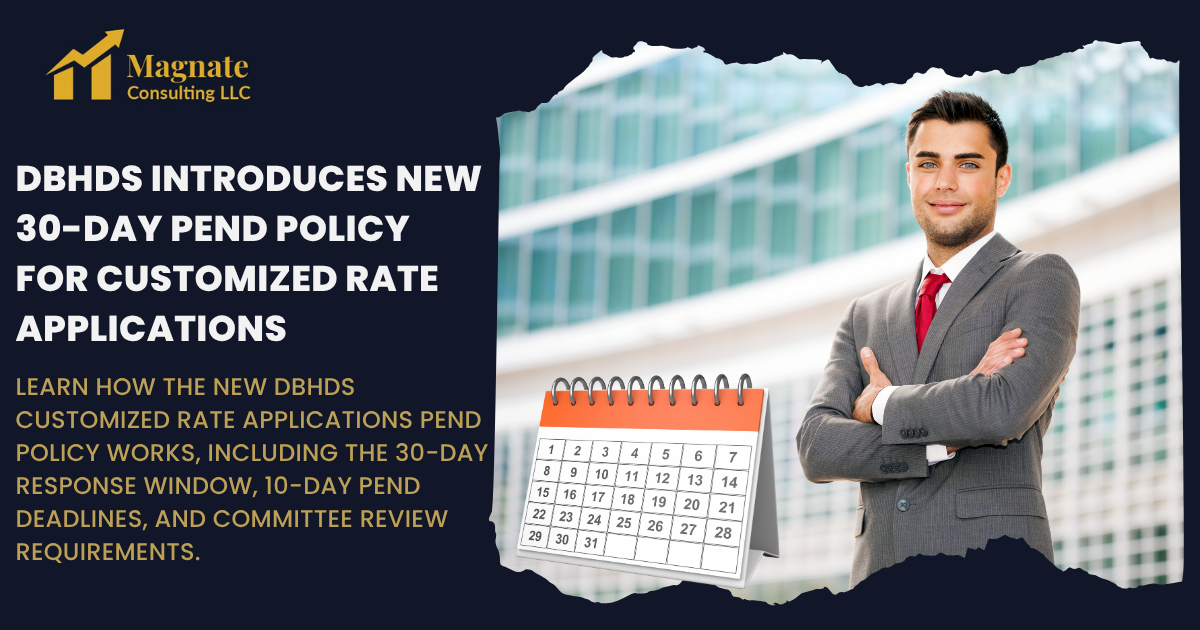
The September 8, 2026 DBHDS pend policy introduces a defined timeline for providers responding to Customized Rate Application requests.
Providers have 30 calendar days from the application’s submission date to provide the required documentation and information.
During that period, DBHDS may issue up to two pend requests when additional or clarifying information is necessary.
However, providers have only 10 calendar days to respond to each pend request.
Most importantly, responding to a pend does not restart the 30-day clock. The pend response period does not independently extend the overall application timeframe.
Therefore, providers should treat every DBHDS communication as time-sensitive.
DBHDS Processing Delays May Adjust the Timeline
The new policy also recognizes that some processing time occurs within DBHDS.
If DBHDS holds an application in its internal review queue for more than three calendar days, days beyond those three are subtracted from the provider’s 30-day response window.
This adjustment is intended to prevent providers from losing application response time because of qualifying internal DBHDS processing delays.
Nevertheless, providers should continue tracking the applicable deadline rather than assuming that additional time will automatically apply.
What Happens When an Application Is Incomplete?
Providers should understand the consequences of allowing the adjusted 30-day timeframe to expire without completing the required submission.
Under the new policy, an incomplete application will automatically proceed to committee review based on the information submitted at that time.
If essential documentation is missing, the application may be denied.
Additionally, a Customized Rate Technical Consultant may deny an application before committee review if the application lacks key components necessary for the committee to evaluate it.
This makes pre-submission quality control critical.
How Providers Can Strengthen Their Applications
A provider can reduce avoidable delays by creating an internal Customized Rate Application checklist before submitting through WaMS.
The checklist should confirm that:
1. The individual meets the applicable customized-rate criteria.
2. The requested staffing and support levels are clearly justified.
3. Required professional documentation is available.
4. Staff qualifications and training support the requested rate.
5. SF-20 is complete and consistent with the application.
6. Required attachments are uploaded to WaMS.
7. The provider has assigned someone to monitor DBHDS communications.
8. All pend deadlines are documented and tracked.
9. Responses are submitted before the applicable 10-day deadline.
10. Copies of all submissions and communications are retained.
This structured approach can help providers identify weaknesses before DBHDS identifies them during review.
Next Steps for Providers
If you plan to submit a Customized Rate Application in 2026, start with documentation rather than waiting for a pend request. Review the individual’s exceptional support needs, confirm that the requested staffing and professional supports are adequately supported, complete the current required forms including the updated 2026 SF-20 and submit the application and attachments through WaMS. Once submitted, establish an internal deadline tracker so your team can respond promptly to every DBHDS communication and remain within the applicable 30-day timeframe.
At Magnate Consulting LLC, we help providers approach complex regulatory and reimbursement processes with greater structure, documentation, and compliance readiness.
Frequently Asked Questions
1. What is a Customized Rate Application?
A Customized Rate Application is a provider request for a Medicaid waiver rate tailored to an individual whose exceptional medical and/or behavioral support needs fall outside the standard reimbursement structure.
2. Where does a provider submit a Customized Rate Application?
Providers submit Customized Rate Applications through WaMS, the Waiver Management System. DBHDS requires supporting documentation to be uploaded with the application.
3. Is Form SF-20 required in 2026?
Yes. DBHDS’s current 2026 Customized Rates guidance identifies the updated 2026 SF-20 as required with all Customized Rate Applications.
4. How long does a provider have to respond to a pend request?
Under the September 8, 2026 pend policy provided for this article, providers must respond to each pend request within 10 calendar days. DBHDS may issue up to two pends during the 30-day review period.