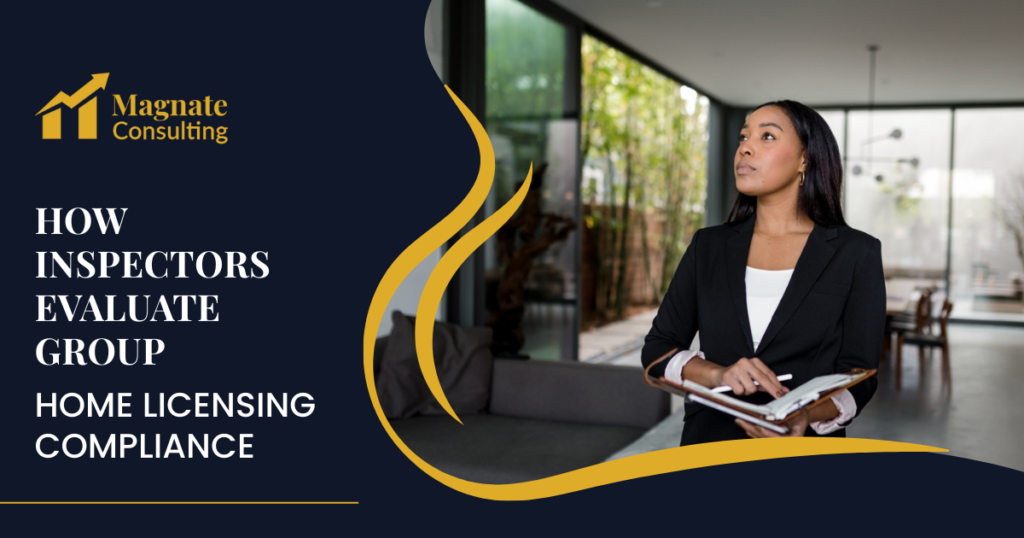
An inspection does not feel like a test until you are sitting across from someone holding a clipboard and asking questions that sound simple but land heavily. Most providers believe group home licensing compliance is about documents. Inspectors know better. They are reading the room, the systems, the people, and the story your organization tells without saying a word.
Licensing reviews are designed to answer one quiet question. Can this organization safely care for vulnerable people, not just today, but months from now, when no one is watching?
Understanding how inspectors evaluate compliance changes everything. It shifts preparation from panic to confidence. From paperwork to readiness. From hoping for approval to earning trust.
What Compliance Really Means to Inspectors
Compliance is not a checklist for inspectors. It is a pattern.
They are trained to look for alignment. Policies that match behavior. Training that shows up in real decisions. Leadership that understands risk before it becomes an incident.
Research in regulatory psychology studies shows that auditors rely heavily on consistency cues when evaluating high-risk environments like healthcare and residential care settings. When systems align, inspectors move faster. When they do not, scrutiny deepens.
Group home licensing consultants help providers translate this understanding into actionable systems that inspectors recognize immediately.
Group home licensing compliance is less about perfection and more about predictability.
The Inspector’s Core Objective
Inspectors are not there to help you succeed. They are there to protect residents.
That mindset shapes everything. They evaluate whether your organization can identify problems early, respond appropriately, and prevent recurrence. They look for operational maturity rather than enthusiasm.
This is why many first-time applicants struggle. Passion is visible. Systems are not.
Inspectors want evidence that your group home can operate safely on its worst day, not just its best one.
What Inspectors Review Before They Arrive
Long before an inspection visit, your application is already speaking.
Inspectors review submissions for internal logic. Dates, staffing ratios, program descriptions, and policies must agree with each other. Inconsistencies trigger questions. Missing details signal risk.
They also compare your application against common failure patterns seen in group home startup consulting cases. Rushed submissions. Copy-pasted policies. Generic language that does not reflect the population served.
When inspectors arrive, they already have a hypothesis. The inspection either confirms it or challenges it.
Facility Readiness and Environmental Signals
The physical environment tells a story that inspectors trust more than words.
They observe safety features, cleanliness, accessibility, and resident flow. But they also notice subtler signals. Are emergency exits blocked? Are medications stored logically? Does the space feel lived in or staged?
Environmental psychology research shows that inspectors unconsciously associate organized spaces with competent management. Disorganized environments increase perceived risk even if policies are strong.
Group home compliance consulting often emphasizes these subtle cues in preparation programs.
Policy and Documentation That Actually Matter
Not all policies carry equal weight.
Inspectors focus on documents that directly affect resident safety and rights. Incident reporting. Medication management. Staff supervision. Emergency response.
They compare written policies to actual practice. If a policy says one thing and staff behavior shows another, the policy becomes evidence against you.
This is where group home compliance consulting provides value. Strong providers write policies that mirror daily operations rather than aspirational language borrowed from templates. Inspectors can tell the difference within minutes. For guidance on incident procedures, refer to incident reporting best practices.
Staff Knowledge and Confidence
Inspectors rarely rely solely on leadership interviews.
They speak with frontline staff because staff responses reveal training quality, role clarity, and organizational culture. Hesitation, conflicting answers, or vague explanations raise concern.
Research in healthcare compliance auditing shows that staff confidence correlates strongly with inspection outcomes. Not confidence from memorization, but confidence from lived practice.
If staff understand why procedures exist, not just how to recite them, inspectors relax.
Resident Care and Rights Protection
Inspectors pay close attention to how dignity shows up in daily routines.
They observe interactions. Privacy practices. Communication tone. Complaint handling. Even small moments like knocking before entering a room matter.
Group home licensing consultants ensure residents’ rights are embedded in daily operations, not just written policies.
Documentation supports this, but behavior proves it.
Operational Systems Under Scrutiny
This is where many providers underestimate the inspection.
Inspectors examine medication logs for accuracy and patterns. They review emergency drills not just for completion, but for realism. They assess supervision structures to see if accountability exists beyond job titles.
Operational systems are the backbone of compliance. Without them, even experienced providers struggle during inspections.
This is why group home business consulting increasingly focuses on systems design rather than surface-level preparation.
Signals That Build Inspector Confidence
Certain signals consistently shorten inspections.
Organized records that can be accessed without stress. Staff who answer calmly and consistently. Leadership that acknowledges limitations without defensiveness.
Inspectors trust organizations that understand their own risks. Transparency builds credibility faster than overconfidence.
Confidence comes from thorough preparation, not last-minute performance.
Red Flags That Trigger Deeper Review
Inspectors are trained to notice patterns that suggest instability.
Over-rehearsed answers. Missing logs. Policies that feel disconnected from reality. Leadership that speaks while staff remain silent.
Another red flag is rushing. Providers who push for approval before systems are ready often face delays or conditional licensing.
Group home licensing consultants help identify these red flags before the inspection ever begins.
How Inspectors Make Final Decisions
Inspection findings are weighted.
Some issues require correction plans. Others delay approval entirely. Inspectors evaluate whether problems are isolated or systemic.
They ask themselves whether this organization learns from mistakes or repeats them.
Approval is not the end of evaluation. It is the beginning of ongoing oversight.
Why Choose Magnate Consulting
Magnate Consulting helps providers navigate group home licensing with expertise in compliance, operations, and growth. Their group home consulting services build trust with inspectors and create lasting organizational confidence.
- Expert guidance at the intersection of group home licensing, compliance, and operations
- Offers group home consulting services, group home compliance consulting, group home expansion services, and operational systems design
- Helps providers build organizations that inspectors trust, not just pass inspections, with support from experienced group home licensing consultants
- Supports multi-state alignment of policies, staff training, and operational systems through group home business consulting
- Reduces delays, minimizes risk, and ensures readiness for inspections, including first-time providers using group home startup consulting
Conclusion
Group home licensing compliance is not a performance. It is a reflection. Inspectors evaluate what exists when no one is watching. They look for systems that protect residents, support staff, and prevent harm.
When providers understand how inspectors think, preparation becomes strategic rather than reactive. Compliance becomes a byproduct of strong operations, not a last-minute scramble. The strongest group homes are not those that fear inspections. They are the ones who are always ready.
Start with clarity. Build with confidence. Book a consultation to assess your readiness before inspectors do.
Frequently Asked Questions
1. What happens during a group home inspection?
Inspectors evaluate readiness, staff knowledge, safety procedures, and resident care. They look for consistent systems that protect everyone in the home.
2. How can providers prepare their team for an inspection?
Preparation involves clear communication of responsibilities, regular training drills, and reviewing internal procedures so staff can confidently demonstrate daily practices.
3. What are common areas where homes fail inspections?
Frequent issues include incomplete documentation, unclear staff roles, inconsistent implementation of policies, and environmental safety concerns.
4. How do inspectors assess resident safety and well-being?
They observe interactions, check privacy measures, review incident reporting procedures, and ensure emergency systems are functional and understood by staff.
5. Why do some inspections take longer than others?
Inspections are longer when systems are disorganized, staff answers are inconsistent, or policies do not match actual practices. Homes with strong processes move through more quickly.